

The Cognitive Trap
In Thinking, Fast and Slow, Daniel Kahneman introduces two modes of thought: System 1 (fast, automatic, intuitive, and effortless) and System 2 (slow, deliberate, analytical, and effortful). Crucially, System 2 is governed by the "law of least effort"—it is inherently lazy and reluctant to invest energy unless forced to do so.
This creates a dangerous vulnerability in IT security management: Cognitive Ease.
-
How the Illusion Works: Kahneman explains that repeated exposure, familiarity, and low-friction processes generate a state of "cognitive ease". When our minds are in a state of ease, we feel comfortable, our vigilance drops, and we fall prey to the Illusion of Truth. As Kahneman notes, "A reliable way to make people believe in falsehoods is frequent repetition, because familiarity is not easily distinguished from truth".
-
The "Available Right" Fallacy: In IT environments, legacy configurations, basic perimeter defenses, or partial mitigations become familiar through daily repetition. Because these practices do not disrupt workflows, they induce cognitive ease. System 1 signals that "everything is fine," and a lazy System 2 endorses the status quo as "acceptable security".
-
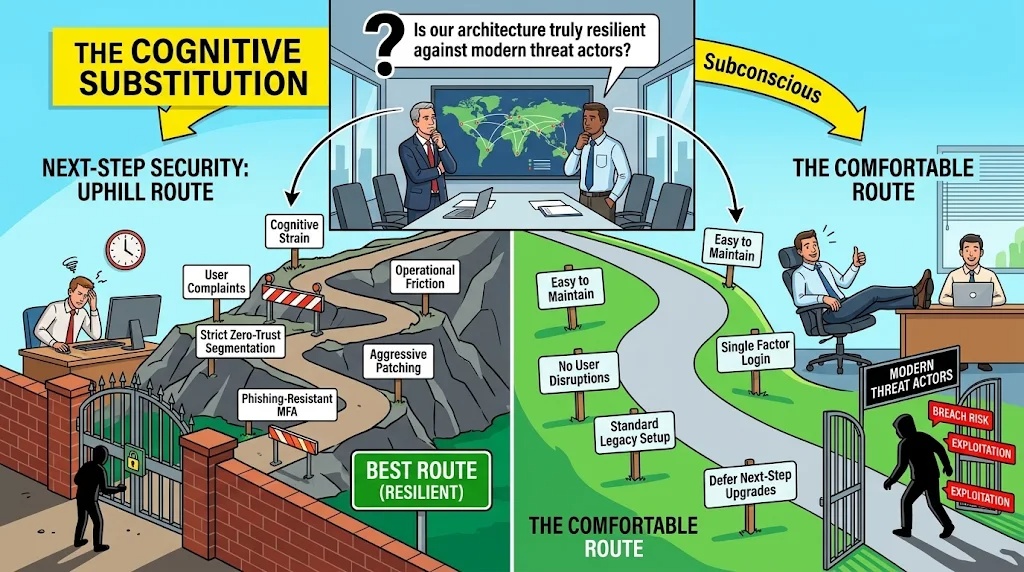
Substitution: Faced with the difficult target question—"Is our architecture truly resilient against modern threat actors?"—security teams and executives unconsciously substitute an easier heuristic question: "Is our current security easy to maintain without disrupting users?" Next-step security (e.g., strict zero-trust segmentation, aggressive patching, phishing-resistant MFA) induces cognitive strain and operational friction, causing leaders to reject the best route in favor of the comfortable route.
Operationalizing Advisories (CISA & CVE) to Trigger "Cognitive Strain"
Kahneman demonstrates that inducing cognitive strain mobilizes System 2, shifting decision-makers from a casual, intuitive mode to a vigilant, analytic mode where fewer errors are made. External threat intelligence—specifically CISA Advisories and CVEs (Common Vulnerabilities and Exposures)—must be used as deliberate triggers to shatter internal cognitive ease.
-
Moving Beyond Passive Monitoring: Treating CVEs and CISA alerts as a passive reading list feeds the illusion of awareness. Instead, organizations must operationalize CISA’s Federal Government Cybersecurity Incident and Vulnerability Response Playbooks, which establish standardized procedures to identify, coordinate, remediate, recover, and track mitigations rather than leaving responses to ad-hoc intuition.
-
Combating WYSIATI (What You See Is All There Is): System 1 builds coherent, comforting stories out of limited local data, ignoring what it cannot see. If an organization hasn't been breached recently, WYSIATI convinces leadership they are safe. Integrating CISA’s Known Exploited Vulnerabilities (KEV) catalog forces teams to confront external base rates—proving that active exploitation is occurring across the ecosystem regardless of local complacency.
-
Standardized Playbooks Over Gut Instinct: CISA’s Vulnerability Response Playbook removes the "negotiation" phase of patching. By pre-committing to standardized operational procedures, teams prevent System 2 from rationalizing delays when a critical CVE drops.
Proven Practices and "Red Team" Advocates: Institutionalizing Doubt
Kahneman points out that System 1 is gullible and biased to believe and confirm, whereas conscious doubt is exclusively the domain of System 2. Because human brains naturally seek confirming evidence (positive test strategy), security teams will naturally look for proof that their defenses work.
-
Red Teams as Institutionalized System 2: Red team advocates serve as an organization's externalized System 2. Their mandate is to challenge the "associative coherence" of internal IT narratives—the comforting story that existing firewalls and policies are sufficient.
-
Decorrelating Error: Kahneman advises that to overcome blind spots and the "halo effect" (assuming a system is secure because one aspect of it passed an audit), organizations must decorrelate error by seeking independent assessments. Red teams provide unvarnished, adversarial testing that exposes the gap between theoretical compliance ("the good route") and actual resilience ("the best route").
-
The First 48 Hours: Drawing from CISA and SAFECOM’s The First 48: What to Expect When a Cyber Incident Occurs, organizations must prepare for the reality of active compromise before it happens. Red team exercises simulate these high-stress windows, proving that untested, "easy" security practices collapse under real-world pressure.
The Elevated Approach vs. The "Risk/Business Balance" Trap
A pervasive mantra in corporate IT is "balancing security with business requirements." While framed as pragmatic, Kahneman’s framework reveals this balance is often a disguised Affect Heuristic and Availability Bias in action.
-
The Flaw in "Weighing" Security Against Business: When executives weigh security against business convenience, the operational friction of security is immediate, vivid, and emotionally salient (inducing dislike). Conversely, the probability of a catastrophic breach feels abstract and distant until a disaster occurs (a cycle economist Howard Kunreuther notes leads to growing complacency as memories of past crises dim). Because System 1 overweights immediate friction and underweights statistical risk, "business requirements" almost always win the debate—until a breach halts business entirely.
-
The Elevated Approach (Security as the Foundation): CISA’s Planning: Response & Recovery toolkit (specifically Essential Elements: Your Crisis Response) emphasizes using Business Impact Assessments (BIAs) not to excuse weak security, but to prioritize critical assets and ensure survival and recovery.
-
Best Route vs. Good Route: Taking the "good enough" route accumulates technical and security debt. When an incident inevitably occurs, the lack of foundational, best-practice controls turns a containable vulnerability into an existential crisis. An elevated security posture rejects the false dichotomy between business enablement and rigorous protection; it recognizes that uncompromised integrity and rapid recoverability are the ultimate business requirements.
Suggested Flow for Your Final Piece
-
Hook: Start with Kahneman’s concept of the "lazy System 2" and how IT teams mistake the absence of friction for the presence of security.
-
The Illusion of Truth in IT: Explain how repeating "this is acceptable risk" makes an insecure practice feel true.
-
The Antidote (CISA & Advisories): Show how CISA Playbooks and CVEs act as objective, System 2 forcing functions to override internal bias.
-
The Adversarial Check: Highlight why Red Teams and proven architectures are non-negotiable for breaking organizational confirmation bias.
-
Conclusion: Reframe the "business vs. security" debate—arguing that choosing the easy route is a short-term cognitive illusion that guarantees long-term operational failure.
Reader Comments (0)
Want to leave a comment? Sign in with your account to participate.
Sign In to CommentNo comments yet. Be the first to join the conversation!