

In modern Agile software delivery, a poorly defined user story is one of the fastest paths to sprint failure. This might be evidenced as tasks that roll from sprint to sprint. Stories that require mid-sprint clarifications, carry hidden platform dependencies, or drag across multiple iterations create friction and bloat operation costs.
To deliver IT services predictably, Agile teams must master writing atomic, high-value, and autonomous user stories that can be started and finished within a standard two-week sprint cycle without constant stakeholder intervention.
1. Grounding in the Core Standard: The INVEST Criteria
To craft stories that drive velocity, teams lean on the INVEST framework (Independent, Negotiable, Valuable, Estimable, Small, Testable).
When aiming for autonomous execution within a two-week sprint, three specific attributes are critical:
-
Valuable: Every story must deliver explicit business or user value, avoiding "tech-for-the-sake-of-tech" debt.
-
Independent: The story must be decoupled from other backlog items so developers can work on it without waiting for parallel tasks.
-
Small: The scope must be tight enough to be designed, coded, tested, and deployed comfortably within a two-week iteration.
2. Defining Explicit Business Value: The "So That..." Clause
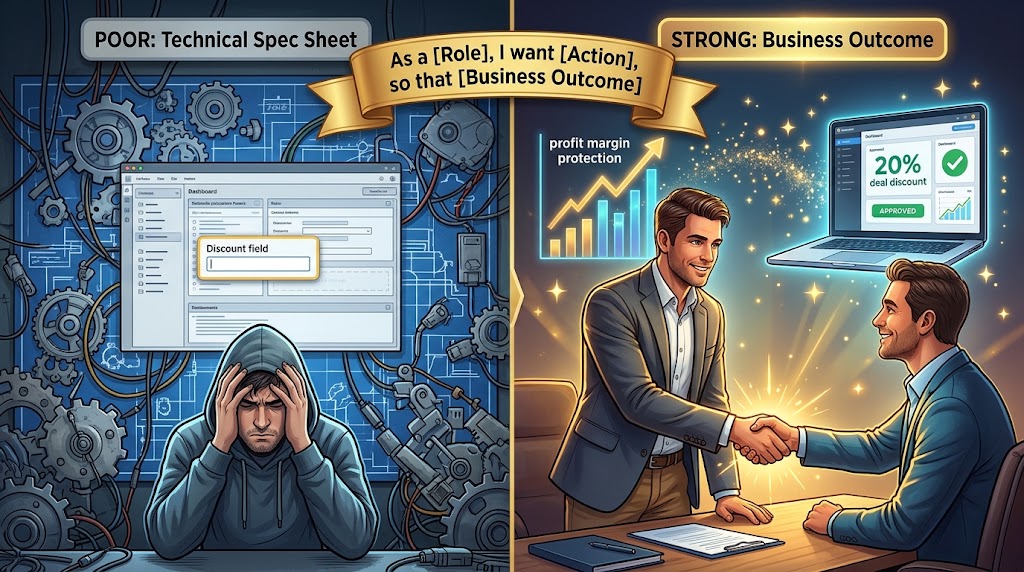
A story is not a technical spec sheet—it is an invitation to realize a business outcome. The classic User Story structure remains the gold standard:
Avoiding Common Value Traps
As highlighted in modern cloud platform implementation methodologies, generic or incomplete user stories often state what to build while failing to state why it matters.
-
Poor: "As an admin, I want a discount field on the Opportunity object." (Describes interface/configuration, not value.)
-
Strong: "As a Benefits Manager, I want to view and approve custom deal discounts above 20% so that we protect profit margins while closing high-value accounts faster."
3. Eliminating Mid-Sprint Stakeholder Blockers (True Independence)
To ensure a developer can pick up a story and complete it without stopping to ask stakeholders for missing business rules, all ambiguity must be resolved before sprint planning. Sometimes, including a technical review from someone unfamiliar with the process can ask the right questions to clarify and tune a story.
Clear Acceptance Criteria (Given-When-Then & Checklists)
Acceptance Criteria (AC) turn abstract intent into verifiable implementation conditions. A complete story includes two levels of criteria:
-
Functional Criteria (Behavior-Driven / Gherkin Format):
-
Given an opportunity with a discount $> 20\%$
-
When the Program Administrator submits it for approval
-
Then an approval task is automatically routed to the Section Lead.
-
-
Access, Data & Boundary Conditions (Checklist Format):
-
Define explicit field-level security, role-based visibility, and validation logic up front (e.g., maximum allowable accural caps, error messages for invalid entries).
-
Resolving Requirements in Refinement
As emphasized in technical software engineering practices (like those outlined in PracHub's Atomic Engineering Guide), a story should never enter a sprint with unresolved specs. Edge cases—such as input validation, missing data states, or error handling—must be settled during initial refinement so engineers can proceed with zero external dependencies during execution.
4. Sizing for the 2-Week Sprint & Deployment Pipelines
A common failure mode in Agile is carrying oversized epics across sprint boundaries. Designing for a 2-week cycle requires radical atomicity and alignment with modern CI/CD deployment pipelines.
Slicing Strategies for 2-Week Delivery
To fit within a 2-week sprint (which includes development, code reviews, automated testing, and deployment):
-
Slice by Rule, Not by Layer: Avoid breaking work into "Frontend Story" and "Backend Story." Instead, slice vertically by specific workflow paths (e.g., "Basic submission flow" in Sprint 1, "Edge case exception handling" in Sprint 2).
-
Automate Quality Gates: Ensure acceptance criteria define testing requirements (unit tests, integration checks) so the story can pass through continuous delivery pipelines into environment validation smoothly.
-
Keep Velocity Estimable: If an engineer cannot estimate the work with confidence—or if a story exceeds roughly 3 to 5 story points—it must be split further into smaller atomic units.
Checklist: Is Your Story Ready for the Sprint?
Before moving a user story to "Ready for Development," verify it against this quick checklist:
| Check | Requirement |
| Business Value | Does the "So That" clause clearly state a quantifiable or qualitative outcome? |
| No Mid-Sprint Blockers | Are business rules, access levels, and edge cases specified so engineers don't need to consult stakeholders? |
| Testable Criteria | Are acceptance criteria written in clear Given-When-Then or pass/fail formats? |
| 2-Week Scope | Can the feature be developed, reviewed, tested, and deployed within a single 2-week cycle? |
| Zero External Blockers | Is the story free from dependencies on parallel, uncompleted backlog items? |
Reader Comments (0)
Want to leave a comment? Sign in with your account to participate.
Sign In to CommentNo comments yet. Be the first to join the conversation!