

There is a time and a place for everything—including how we talk about our work.
In project management, there is a fundamental difference between a status report and a progress update. A status report is a periodic, high-level snapshot of overall project health, budget, and timeline aimed at aligning stakeholders and decision-makers. A daily standup update, on the other hand, is a fast, tactical check-in designed to keep the immediate team aligned, surface dependencies, and unblock daily execution.
When we blur the lines between the two—or treat a 15-minute standup like a deep-dive working session—updates become bloated, confusing, and exhausting. To keep our daily syncs sharp, complete, and under two minutes per person, here is an exhaustive list of practices to avoid during your standup update.
1. Confusing Status Reporting with Daily Updates
* Giving the "Executive Summary" instead of tactical actions: Save high-level metrics, burn rates, and overall project health scores for formal weekly or monthly status reports. Your team needs to know what you are actively moving forward today.
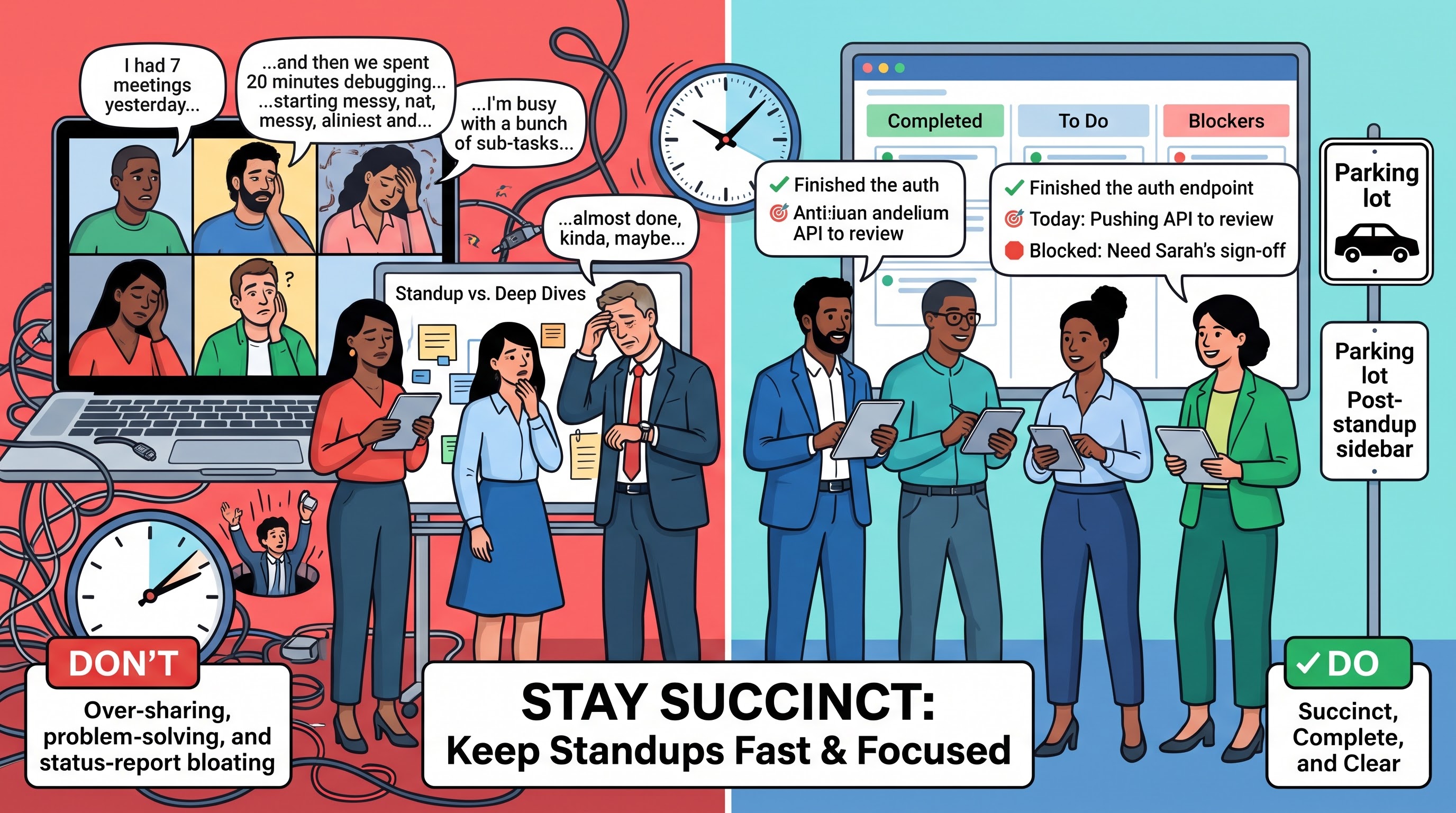
* Reciting your entire calendar: Nobody needs a play-by-play of every meeting you attended yesterday. Unless a meeting produced a deliverable, a decision, or a blocker that affects the team, leave it out.
* Listing every minor micro-task: Don't read off every sub-task or ticket number on your to-do list. Summarize completed work into one or two meaningful outcomes.
* Reporting "busyness" instead of progress: Saying "I worked on the API all day" tells the team nothing about where the work actually stands. State what changed or what was completed (e.g., "I finished the authentication endpoint and pushed it for review").
2. Hijacking the Clock with Deep Dives
* Problem-solving in real time: The standup is for identifying blockers, not fixing them. The moment two people start debugging code or debating design choices, take it to the "parking lot" for an offline sidebar after the meeting.
* Giving a technical or jargon-heavy monologue: Keep your update accessible to the whole cross-functional team. If only one other person in the room understands what you’re talking about, save the granular details for a 1:1.
* Turning your update into a brainstorming session: Standups are for alignment and triage, not ideation. Bring solutions or specific questions to a dedicated working session rather than thinking out loud on the clock.
* Rehashing old news: Focus strictly on what changed since the last standup and what is happening in the next 24 hours. Avoid re-explaining background context the team already knows.
3. Leaving Out Critical Context (Incomplete Updates)
* Hiding or sugarcoating blockers: Delaying bad news to avoid looking behind schedule destroys team trust and turns minor delays into major crises. Surface roadblocks the moment they appear.
* Stating a blocker without naming what you need: Don't just say, "I'm stuck on the design." Specify the exact dependency and owner: "I'm blocked until Sarah signs off on the final header mockups".
* Forgetting to mention cross-team dependencies: If your work today relies on someone else finishing their task—or if your work will hand off to someone else tomorrow—call it out explicitly so nobody is caught off guard.
* Using vague timelines: Avoid phrases like "almost done," "wrapping up soon," or "making good progress." Be concrete about when a deliverable will be ready for handoff or review.
4. Poor Preparation and Delivery Habits
* Winging it when it's your turn: Don't spend your two minutes scrolling through Jira, Slack, or your notebook trying to remember what you did yesterday. Take 60 seconds before the meeting to jot down your three core points: Completed, Today, Blockers.
* Reporting to the manager instead of with the team: A standup isn't a status interrogation by a project lead. Speak to your peers—they are the ones whose daily work depends on yours.
* Using the standup to justify your existence: You don't need to prove you worked hard by padding your update with fluff or minor administrative chores. Trust that concise, outcome-focused updates speak for themselves.
* Multitasking until your name is called: Checking Slack or answering emails while teammates speak causes you to miss key dependencies—and leads to you repeating information someone else just covered.
The Golden Rule: Keep It to the Big Three
If you ever feel your update drifting into status-report territory or running past the two-minute mark, reset and answer only these three questions:
* What did I finish since we last met? (Outcomes, not effort)
* What am I committing to before we meet again? (Priorities, not a wish list)
* What is in my way? (Blockers and who can help clear them)
Everything else belongs in your project tracker, a weekly status report, or a follow-up conversation.
Reader Comments (0)
Want to leave a comment? Sign in with your account to participate.
Sign In to CommentNo comments yet. Be the first to join the conversation!