
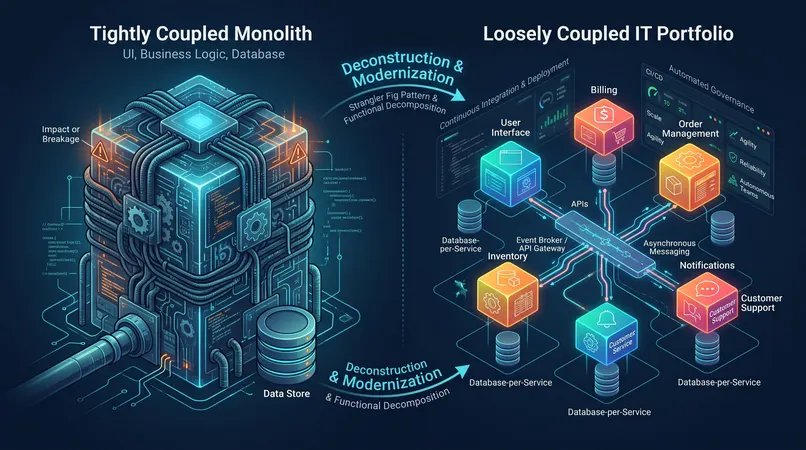
A tightly coupled, monolithic application binds user interfaces, business logic, and data access into a single, interdependent codebase. While straightforward to build initially, monoliths become cumbersome and slow to adapt as they grow—a small change in one module risks breaking the entire system, forcing teams into coordinated, high-risk releases.
By contrast, a loosely coupled IT portfolio decomposes large applications into independent, self-contained microservices. Each service encapsulates a specific business function, owns its own data store, and communicates with other services through well-defined APIs or asynchronous messaging rather than shared memory or direct database calls.
Core Benefits of Loose Coupling
Moving from a rigid monolith to a loosely coupled portfolio shifts IT from a maintenance bottleneck into an engine for business agility:
Accelerated Innovation & Independent Deployment: Because services have minimal dependencies, cross-functional teams can build, test, and deploy updates on their own schedules without waiting for a monolithic release train.
Granular Scalability & Cost Efficiency: Instead of scaling an entire application to handle a traffic spike in one feature, individual services scale independently based on real demand. Once legacy overlaps are retired, cloud spend directly reflects actual traffic rather than blanket over-provisioning.
Fault Isolation & Resiliency: In a tightly coupled system, a memory leak or bug in one module can bring down the whole platform. Loose coupling contains failures within a single domain, protecting core business operations from cascading outages.
Technology Flexibility (Polyglot Architecture): Teams can select the best programming language, framework, or database engine for a specific service's workload rather than being locked into a decade-old legacy stack.
How to Break Up Function: Decomposition Patterns
Decomposing a brownfield monolith requires carving out clear boundaries without disrupting active users. Depending on your system's structure, architects rely on several proven patterns:
Defining the Boundaries
Decompose by Business Capability: Split the application along the lines of what the business actually does to generate value (e.g., Order Management, Billing, Customer Support). This aligns software boundaries with stable business functions.
Decompose by Subdomain (Domain-Driven Design): For complex domains, break capabilities further into bounded contexts (e.g., splitting Marketing into Campaigns, Analytics, and Reporting) so each service operates with a clear, isolated domain model.
Service per Team: Assign ownership of each extracted microservice and its codebase to a single autonomous team, minimizing cross-team coordination overhead.
Decompose by Transactions: When latency is critical and two functions must execute together to complete a single business transaction without two-phase commit overhead, group them intentionally—while guarding against accidentally recreating a mini-monolith.
Executing the Migration Safely
The Strangler Fig Pattern: Rather than a risky "big bang" rewrite, wrap the monolith and replace it incrementally:
1. Transform: Build a new microservice for a well-understood candidate function in parallel with the legacy app.
2. Coexist: Place an API gateway or HTTP proxy at the perimeter to intercept calls and route traffic to the new service while keeping the monolith intact as a fallback. Use feature flags to decouple technical deployment from business release.
3. Eliminate: Once the microservice is validated under production load, retire the legacy code path.
Branch by Abstraction: When a target module sits deep inside the codebase and cannot be intercepted at the network perimeter, introduce an internal abstraction layer, build the new implementation behind it, switch callers over gradually, and remove the old code.
How to Break Up Data: Decentralizing Persistence
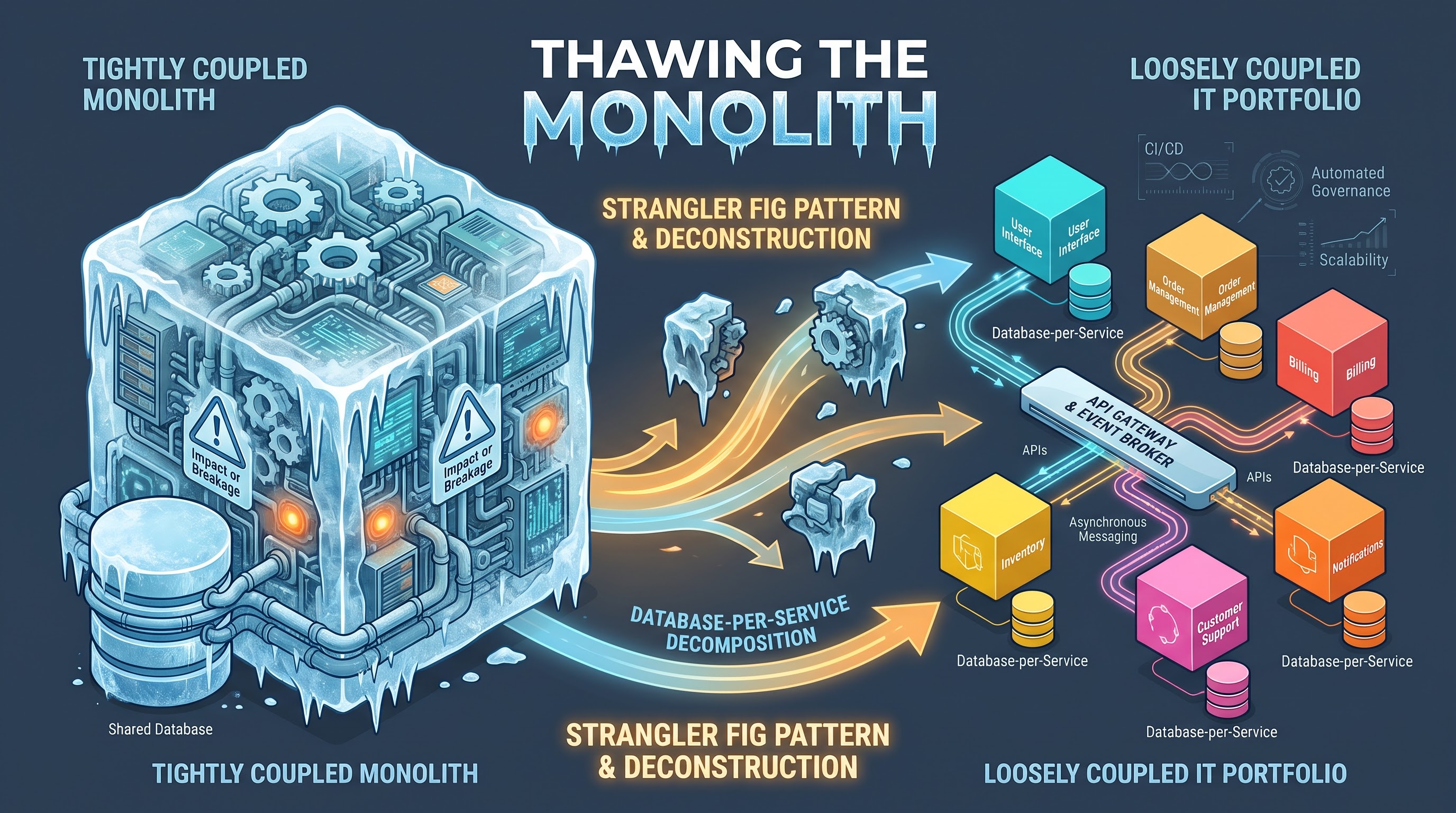
Splitting code without splitting the underlying database simply creates a "distributed monolith". True loose coupling requires decentralizing data persistence:
Database-per-Service: Give each microservice its own private data store. Other services cannot query its tables directly; they must request data through its API. This enables polyglot persistence—using a relational database for transactional integrity in one service and a NoSQL store for high-throughput lookups in another.
Asynchronous Messaging & Event Sourcing: Replace synchronous, blocking API chains with event brokers and message queues. When a service updates its state, it publishes an event that downstream services consume asynchronously, eliminating temporal coupling.
CQRS (Command Query Responsibility Segregation) & API Composition: Because data is spread across multiple databases, cross-domain reporting requires new patterns. Use API Composition to aggregate data on the fly from multiple services, or CQRS to separate write operations (commands) from read-optimized views (queries) updated via event streams.
The Saga Pattern: Manage multi-service business transactions without distributed locks by choreographing a sequence of local transactions, complete with compensating actions to roll back changes if a step fails.
Navigating the "J-Curve": Temporary Trade-Offs
Stakeholders often expect immediate savings and speed, yet loose coupling introduces temporary friction during the transition that must be managed proactively:
Reader Comments (0)
Want to leave a comment? Sign in with your account to participate.
Sign In to CommentNo comments yet. Be the first to join the conversation!