

When dynamite detonates, chemical bonds shatter and re-form, unleashing energy through familiar thermodynamics. When a uranium nucleus splits in a reactor, matter itself is directly reorganized at the subatomic scale, generating millions of times more energy per gram.
Understanding this disparity requires tracing energy release back to two fundamental interactions: the electromagnetic force operating between valence electrons and the strong nuclear force binding nucleons together.
1. The Fundamental Forces and Potential Wells
Every chemical reaction—from the combustion of methane to ATP hydrolysis—is governed by quantum electrodynamics (QED). Chemical energy is electrostatic potential energy stored within valence electron orbitals.
Breaking chemical bonds always requires an input of energy (endothermic bond dissociation), while forming new, thermodynamically more stable bonds releases energy. As explored in discussions of why chemical reactions release or absorb heat, net energy release (delta_H < 0) occurs only when the electrostatic attractions in the product molecules are deeper and more stable than those of the reactants.
The classical electrostatic force follows Coulomb's inverse-square relation:
1 q_1 * q_2
F_Coulomb = ---- * -----------
4*pi*e_0 r^2
In molecular systems, the relevant interaction distance sits at the angstrom scale:
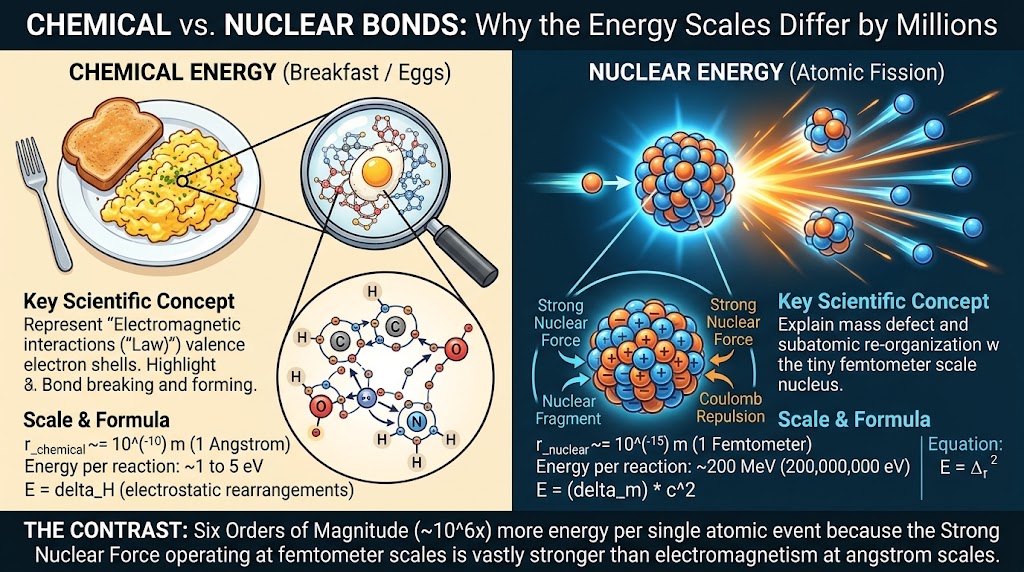
r_chemical ~= 10^(-10) m (1 Angstrom)
Because of this spatial scale and the magnitude of the elementary charge, individual chemical bond dissociation energies typically range from 1 to 5 electron volts (eV) per event.
Nuclear reactions operate in an entirely different physical domain. The atomic nucleus is bound by the residual strong nuclear force, an interaction mediated by mesons acting between protons and neutrons. This force is short-range:
r_nuclear ~= 10^(-15) m (1 Femtometer / Fermi)
At this separation, the strong force is roughly 100 to 137 times stronger than electrostatic repulsion. Because the spatial coordinate r is five orders of magnitude smaller and the coupling strength is vastly higher, the depth of the nuclear potential well is measured in mega-electron volts (MeV) rather than eV.
2. Mass Defect and Relativistic Equivalence
In chemistry, mass conservation (sum(m_reactants) ~= sum(m_products)) holds true for practical laboratory measurements. Although relativistic mass-energy equivalence:
E = (delta_m) * c^2
technically applies to chemical enthalpy changes:
delta_m = (delta_E) / c^2
the mass defect for a reaction yielding a few eV is on the order of 10^(-35) kg—less than one part in a billion of molecular mass.
In nuclear fission, the mass defect is substantial and directly measurable. As outlined by the U.S. Department of Energy and instructional overviews on nuclear fission and fusion, when a heavy fissile nucleus such as Uranium-235 captures a thermal neutron, it forms a transient compound nucleus that fragments:
235 1 141 92 1
U + n ---> Ba + Kr + 3 n + Q
92 0 56 36 0
The difference between initial and final rest masses yields the mass defect:
delta_m = m_reactants - m_products
delta_m ~= 0.215 u
Using the atomic mass unit conversion factor:
1 u ~= 931.5 MeV / c^2
we calculate the reaction energy release (Q-value):
Q = (delta_m) * c^2
Q ~= (0.215 u) * (931.5 MeV / u)
Q ~= 200.27 MeV (~= 200 MeV)
A single fission event yields approximately 200 MeV, compared to the 4 to 9 eV released by burning a single hydrocarbon fuel molecule.
3. Kinetic Partitioning: Where the Energy Goes
The kinetic and spectral signatures of the energy released also differ fundamentally between molecular and nuclear events:
| Characteristic | Molecular Reactions (Combustion, Detonation) | Nuclear Reactions (Fission of 235U) |
| Primary Mediating Force | Electromagnetism | Residual Strong Force / Coulomb Repulsion |
| Energy Scale per Event | $1\text{ – }10\text{ eV}$ | $\approx 200\text{ MeV}$ ($2 \times 10^8\text{ eV}$) |
| Mass Loss ($\Delta m / m$) | $\sim 10^{-10}$ (negligible) | $\sim 10^{-3}$ ($\approx 0.1\%$ of total mass) |
| Initial Energy Forms | Molecular vibrations, rotations, electronic excitation | High-velocity fission fragments, prompt $\gamma$-rays, neutrons |
| Primary Emission Spectrum | Infrared, visible photons, shock pressure waves | Ionizing radiation ($\gamma$, high-energy neutrons, $\beta^-$ decay) |
| Energy Density | $\sim 40\text{ – }50\text{ MJ/kg}$ (fossil fuels) | $\sim 80{,}000{,}000\text{ MJ/kg}$ (pure fissile fuel) |
4. Macroscopic Implications: Energy Density in Practice
Because of this million-fold scaling factor at the quantum level, macroscopic fuel requirements diverge dramatically. According to data tracked by the U.S. Energy Information Administration (EIA), a single standard uranium fuel pellet (roughly 7 grams, about the size of a fingertip) contains the energy equivalent of:
-
3 barrels of oil (126 gallons)
-
1 ton of coal (2,000 pounds)
-
17,000 cubic feet of natural gas
Chemical bond rearrangement shifts outer-shell electrons over angstrom scales via electromagnetism; nuclear fragmentation releases energy from the fundamental mass defect governed by the strong nuclear force at the femtometer scale. The six orders of magnitude dividing their energy yields reflect this shift in length scale and interaction strength.
Reader Comments (0)
Want to leave a comment? Sign in with your account to participate.
Sign In to CommentNo comments yet. Be the first to join the conversation!